What a finish! Over two packed days in Helsinki, the TEATIME community came together to celebrate a four-year journey and set the tone for what comes next in home-cage monitoring (HCM). Seventy-four people attended in-person and were joined by 113 online. The meeting felt like a reunion and a launchpad at once: young researchers, senior researchers, industry partners and funders mingled without boundaries. The atmosphere was warm, generous, and strikingly open – exactly the spirit that has made TEATIME such a productive network.
Session 1 – Legacy of TEATIME: closing the circle
The opening session traced TEATIME from a small pandemic-era discussion group to a mature network. We heard how the community didn’t just critique the literature, it built enduring resources: a living catalogue of ~50 HCM technologies that people refer to find a system that best suits their needs; the popular and expanding Behaviour Forum that lowers the barrier for advice, troubleshooting, and collaboration; and the push toward shared language with the Mouse Behaviour Ontology to harmonize what we measure and how we describe it.
Session 2 – COST: building bridges, boosting careers
This session captured TEATIME’s human impact. Young Researchers spoke about finding a voice and support through training schools, short-term scientific missions, and the confidence to lead sub-working groups. We also heard how classic labs are weaving HCM into everyday neuropharmacology, not as an expensive add-on but as a path to better welfare and better data. COST has not supported just travel; it has brought together a generation of young researchers who now see collaboration and open exchange as default settings.

Session 3 – Short talks from selected abstracts
Talks spanned computational affect in mice, refinement in CNS injury and repeated anaesthesia models, AI-derived digital biomarkers for early disease detection, and translational heart-rate dynamics that connect mouse telemetry to human risk signatures. We also saw the practical side of innovation: low-cost pre-weaning phenotyping, an RFID-based mouse position system for preference tests, and an open-source platform that synchronises feeding behaviour with brain signals.
Session 4 – From bedding to bedside
The morning bridged animal and human work. We saw transdiagnostic frameworks for social dysfunction backed by coherent biomarkers across species; mobile EMA/EMI approaches that capture human craving in real life and deliver help at the right moment; and a tour of “physiological sensing anywhere” that underscored how low-cost hardware and open software can enable continuous monitoring.
Session 5 – Bridging drug discovery and animal welfare
Talks emphasised a changing landscape: reproducible, high-quality in vivo data and welfare refinement are not trade-offs but twin drivers. Discussion centred on challenges we all recognise: standardisation, metadata, computational load and concrete responses, including FAIR portals for preclinical data sharing, defined metadata practice, and conversations about ethics and security.
Session 6 – From idea to ideal: success stories
Evolving efforts to automate circadian and sleep assessment showed how careful design and shared tooling can scale beyond the originating lab. Live Mouse Tracker illustrated sophisticated group-housing phenotyping that still respects social complexity. FED3 reminded us how an affordable, opensource device can transform what is feasible in home-cages.
Session 7 – Future perspectives beyond TEATIME
Talks detailed machine-learning pipelines robust enough for months-long continuous monitoring; HCM as a proactive strategy for uncovering CNS safety risks that legacy tests miss; and strategic foresight for a volatile research world. The closing contribution on a FAIR repository for HCM data showed the TEATIME community at its best: cross-institutional, deliberately standards-driven, and determined to make sharing the path of least resistance.
Poster session highlights
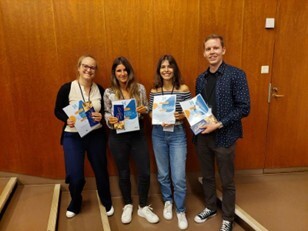
The poster session after the main meeting on Day 1 was a good occasion to mingle and talk about research. All posters (20) generated high interest and engaging discussions. Delegates were also given the chance to vote for their favourite posters, and the “winners” were Andrea Leuthardt (University of Zurich, Switzerland), Alice Melloni (Italian Institute of Technology, Genova, Italy), Daniela Duarte-Domingues (Center for Research in Neuroscience in Lyon, France) and Oskar Ikäheimo/ Gabriel Peinado Allina (Aalto University, Finland).
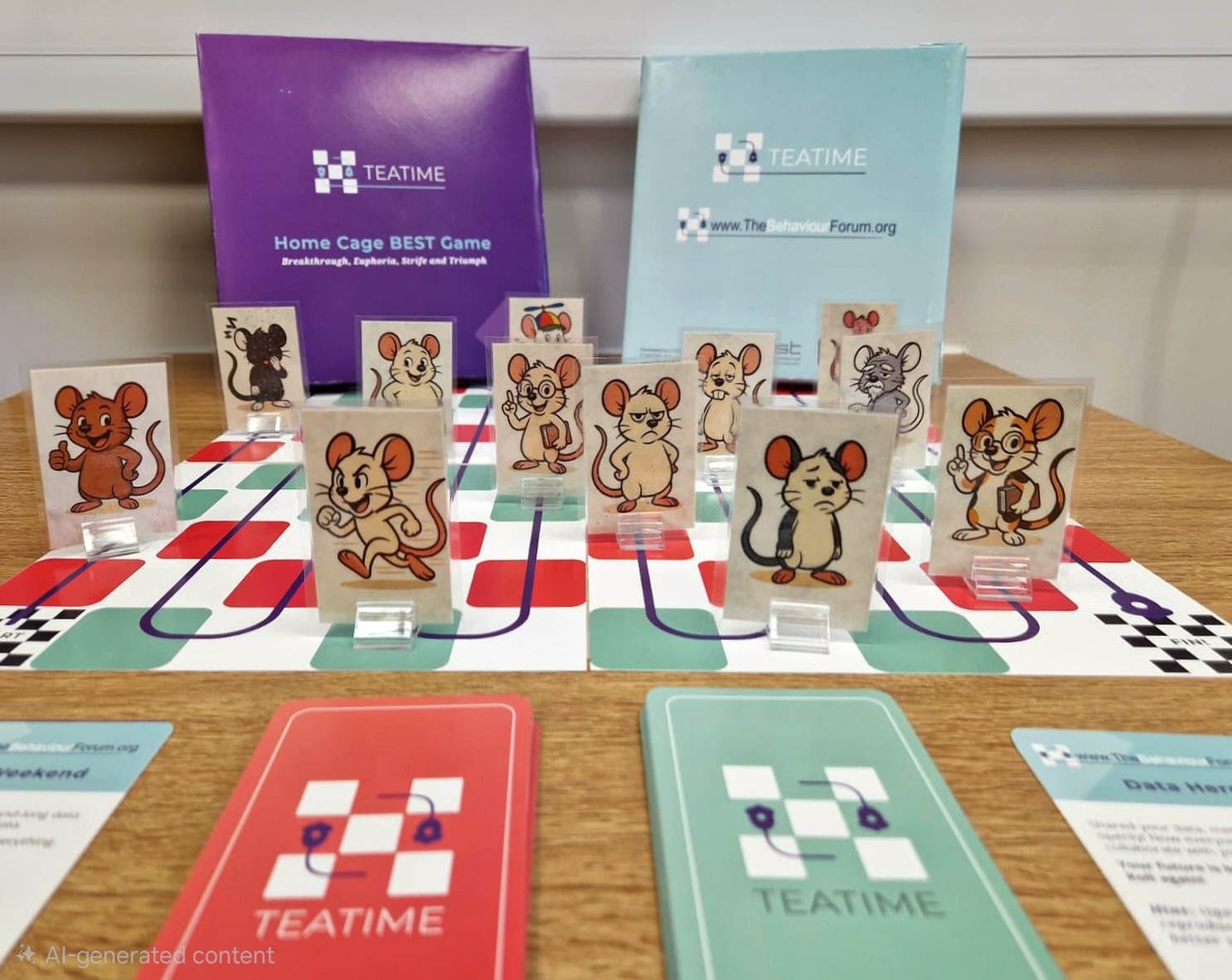
There was also the chance to play the new TEATIME-BEST boardgame which was a fun and engaging way to promote best practices in home-cage monitoring, encompassing the entire journey of a potential user, aimed to encourage engagement for every level of user, from plug and play users to DIY enthusiasts. The ideas and practices promoted in this game were an amalgamation of all the discussion from the ‘problem solving café’ held in the first year of the TEATIME WG3 and then from a dedicated thread on the TEATIME open Q&A forum (www.thebehaviourforum.org). Not to mention the myriad of conversations that TEATIME meetings have promoted over its lifetime.
Overall impressions
If one word captured the meeting, it was generosity. Senior researchers took time to mentor, younger colleagues brought ideas and industry partners engaged as collaborators. Delegates embraced the 3Rs as a route to better science. Coffee breaks ran long (in the best way), and the general interactions, including the conference dinner, demonstrated that this is a community that enjoys working together.
While the TEATIME Action formally ends in October 2025, the infrastructure and relationships are very much alive: the Behaviour Forum as a shared platform; the HCM technology catalogue as a gateway for new users; a maturing plan for a FAIR HCM repository that could unlock sharing and meta-analysis using AI and a number of joint publications underway. All this combined with new; lasting relationships built between members that will carry on providing support and opportunities to work together well beyond the life of the Action.
Our sincere thanks to the University of Helsinki and the Helsinki Institute of Life Science for providing a great venue and being excellent hosts and to the COST Association for supporting the network. And finally, thanks to everyone who attended in-person and online and to all the presenters of talks and posters.
Let’s keep the TEATIME conversation going and together continue to shape the future of home-cage monitoring.